

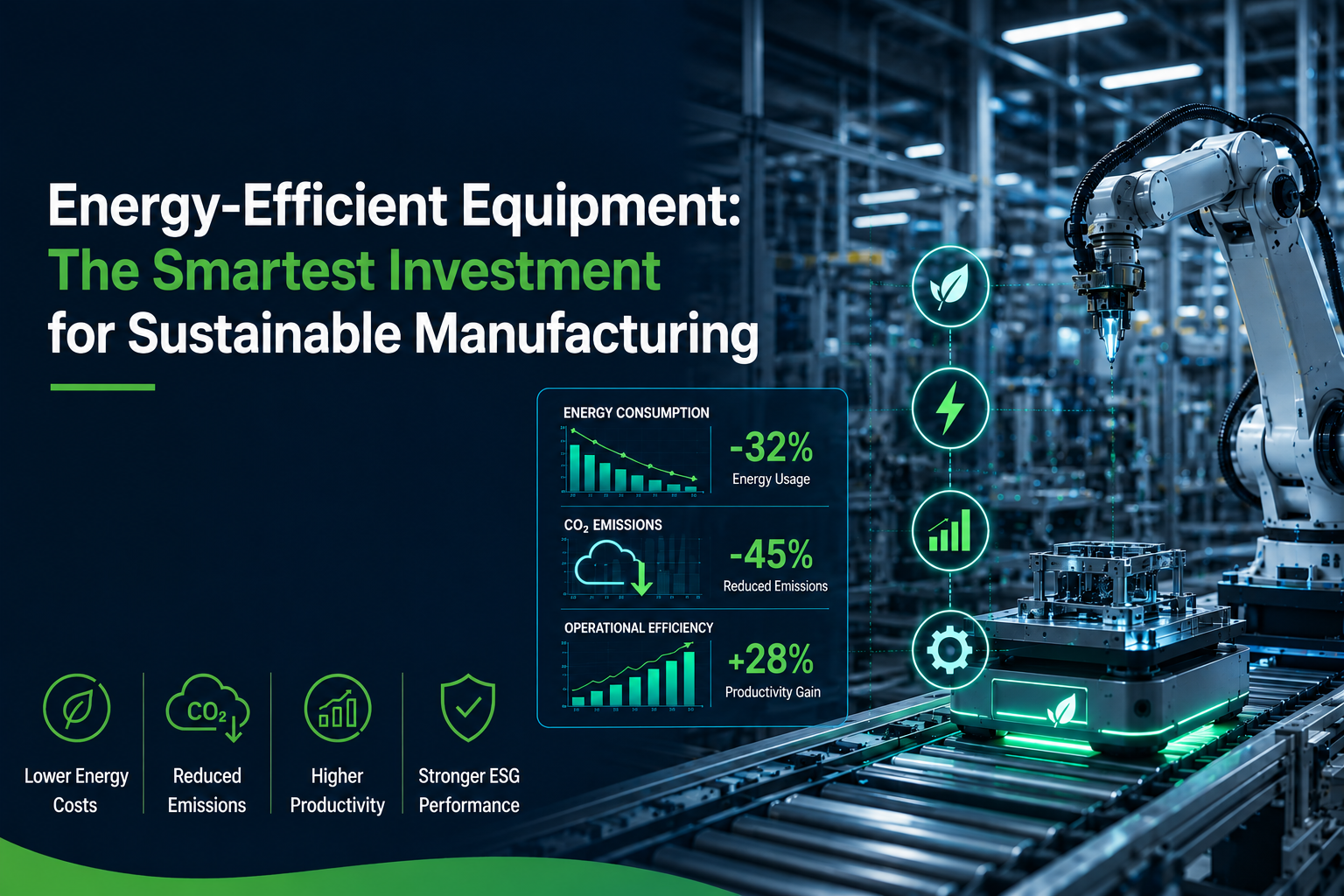
Energy efficiency is no longer just about reducing utility bills, but it’s about building a more resilient, competitive and sustainable manufacturing operation.
Manufacturers today are under increasing pressure to improve productivity while reducing energy consumption, operational costs and greenhouse gas emissions. At the same time, investors, customers, regulators and global sustainability frameworks are demanding greater transparency around environmental performance and measurable progress toward sustainability goals.
The challenge is clear: How can manufacturers produce more while consuming less?
The answer lies in the strategic adoption of energy-efficient automation technologies.
Modern automation is no longer limited to increasing production speed. Today’s intelligent manufacturing systems optimize energy use, improve operational efficiency and generate the real-time data needed to support informed decision-making, ESG reporting and long-term sustainability strategies.
From Automation to Intelligent Energy Management
Manufacturing is evolving into a connected ecosystem where machines, sensors and software work together to optimize energy usage in real time. Technologies such as high-efficiency motors, Variable Frequency Drives (VFDs), servo-driven systems, industrial robots, smart sensors and IoT-enabled controllers automatically adjust power consumption based on actual production requirements. Instead of operating at fixed speeds or consuming unnecessary energy during idle periods, modern equipment dynamically responds to changing operational conditions.
Modern energy-efficient equipment incorporates technologies designed to minimize energy consumption without compromising performance, including:
How Energy-Efficient Equipment Creates Business Value?
Energy is one of the largest operating expenses in manufacturing. Traditional equipment often consumes power even when production demand is low, resulting in unnecessary energy losses.
Modern automation systems overcome this challenge through intelligent controls that optimize equipment operation in real time. Automated systems ensure that machines consume only the energy required for specific production tasks. Features such as regenerative braking, intelligent power management, variable speed control and low-power operating modes minimize unnecessary electricity consumption while maintaining high levels of productivity. By reducing energy waste without compromising performance, manufacturers can lower operating costs, improve profitability and maximize the return on their technology investments.
Reducing electricity consumption directly contributes to lowering Scope 2 greenhouse gas emissions, making energy-efficient equipment an important component of corporate decarbonization strategies.
Beyond environmental benefits, improved energy performance supports compliance with leading sustainability frameworks and reporting standards.
Energy efficiency and operational efficiency go hand in hand.
Modern equipment operates under optimized conditions, reducing mechanical stress, improving process stability and extending asset life. Manufacturers benefit from higher equipment utilization, fewer unexpected breakdowns, improved product quality and increased production throughput.
Rather than viewing energy efficiency as an operational expense, organizations are increasingly recognizing it as an investment that delivers measurable business value through lower maintenance costs, improved reliability and greater operational resilience.
The greatest advantage of modern energy-efficient equipment is the data it generates. Connected machines, industrial robots, machine vision systems and smart sensors continuously capture information on energy consumption, equipment utilization, production output and operating conditions. When analysed effectively, this data helps manufacturers identify inefficiencies, benchmark performance across facilities, detect anomalies, improve quality and prioritize energy-saving initiatives.
Instead of relying on periodic energy audits, manufacturers can make informed decisions based on real-time operational insights, enabling continuous improvement rather than one-time optimization.
AI: The Next Step in Energy-Efficient Manufacturing
AI extends the value of energy-efficient equipment by converting operational data into actionable intelligence. Rather than simply monitoring energy consumption, AI can identify patterns, predict future demand and recommend operational improvements before inefficiencies impact production.
Recent advances in AI-powered manufacturing highlight four key capabilities:
This allows organizations to simulate production scenarios, evaluate energy-saving opportunities, and optimize operations before implementing changes on the factory floor.
Turning Energy Data into Sustainability Intelligence with CeroED
Implementing energy-efficient equipment is only the first step. The real value lies in continuously monitoring equipment performance and transforming operational and energy data into measurable sustainability outcomes. Many organizations struggle with fragmented systems, disconnected spreadsheets and manual reporting, making it difficult to convert data into actionable insights.
At CeroED, we help organizations bridge this gap through ARRO, our sustainability platform that connects operational data with ESG intelligence. By integrating energy consumption, equipment performance, carbon accounting and sustainability reporting into a single platform, ARRO enables manufacturers to monitor performance in real time, benchmark facilities, automate emissions calculations and generate actionable insights that support continuous improvement.
This integrated approach empowers organizations to move beyond compliance, enabling data-driven decisions that improve operational efficiency while advancing long-term sustainability goals.
Want to know how ARRO operates?
Email us at info@ceroed.com
Visit www.ceroed.com
#EnergyEfficiency #OperationalEfficiency #ESG #CeroED #ARRO #Sustainability
CEROED PTE LTD
25 Bukit Batok Crescent #09-05,
Singapore 658066
info@ceroed.com
www.ceroed.com
CeroED Technologies Pvt Ltd
17/1680/5, 1st floor,
Chelsma Heights, Poojappura,
Thiruvananthapuram 695012,
Kerala, India
Copyright @CeroED 2023. All rights reserved.