

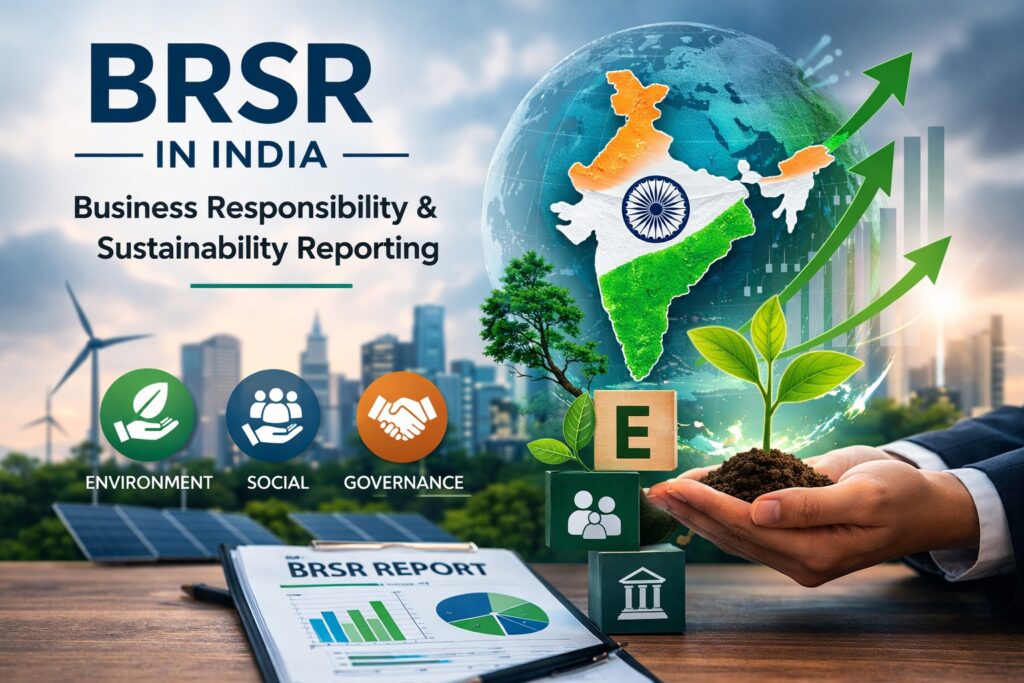
BRSR Explained: India’s Sustainability Framework for Responsible Business

Sustainability reporting is now mandatory for large, listed companies in India. Introduced by the Securities and Exchange Board of India (SEBI), Business Responsibility and Sustainability Reporting (BRSR) is India’s standardized ESG disclosure framework, applicable to the top 1000 listed companies by market capitalization as part of their annual reporting.

In simple terms, BRSR requires companies to disclose how they operate ethically, manage environmental impact, treat employees and communities and maintain strong governance systems. It replaces the earlier Business Responsibility Report (BRR) with more structured and measurable disclosures.

The 9 Core Principles of BRSR

BRSR is based on the National Guidelines on Responsible Business Conduct (NGRBC). Below are the 9 principles explained briefly:

  • Principle 1 – Ethics, Transparency & Accountability
    Businesses must operate with integrity, strong governance and zero tolerance for corruption.
  • Principle 2 – Sustainable Goods & Services
    Products and services should be safe, resource-efficient and environmentally responsible.
  • Principle 3 – Employee Well-being
    Companies must ensure fair wages, safe workplaces, diversity and equal opportunity.
  • Principle 4 – Stakeholder Engagement
    Businesses should identify and respond to the needs of all stakeholders, not just shareholders.
  • Principle 5 – Human Rights
    Companies must respect human rights across operations and supply chains.
  • Principle 6 – Environmental Protection
    Organizations should reduce emissions, manage waste, conserve water and protect biodiversity.
  • Principle 7 – Responsible Public Policy
    Engagement in policy advocacy and industry associations must be transparent and ethical.
  • Principle 8 – Inclusive Growth & Community Development
    Businesses should contribute to social and economic development through meaningful initiatives.
  • Principle 9 – Responsible Consumer Engagement
    Companies must ensure product safety, transparent communication and strong grievance mechanisms.

Why BRSR Matters

BRSR improves:

  • Transparency for investors
  • ESG comparability across companies
  • Risk identification and management
  • Long-term business resilience

It also aligns Indian reporting practices more closely with global sustainability frameworks such as the Global Reporting Initiative (GRI) and the International Sustainability Standards Board (ISSB).

BRSR in ARRO: Simplifying Compliance

ARRO helps in BRSR compliance by:

  • Centralizing ESG data in one platform
  • Mapping data directly to BRSR principles
  • Tracking emissions, energy, water, and waste
  • Monitoring BRSR Core indicators
  • Generating structured, audit-ready reports

With ARRO, BRSR shifts from being just a reporting requirement to becoming a structured and strategic approach to managing sustainability performance.

Want to know more?

Contact us at info@ceroed.com

Visit www.ceroed.com 

#BRSR #Sustainability #Standards #Frameworks #SEBI #ESG #ARRO #CeroED

footer_logo_new

CEROED PTE LTD
25 Bukit Batok Crescent #09-05,
Singapore 658066
info@ceroed.com
www.ceroed.com

CeroED Technologies Pvt Ltd
17/1680/5, 1st floor,
Chelsma Heights, Poojappura, 
Thiruvananthapuram 695012, 
Kerala, India

Copyright @CeroED 2023. All rights reserved.