

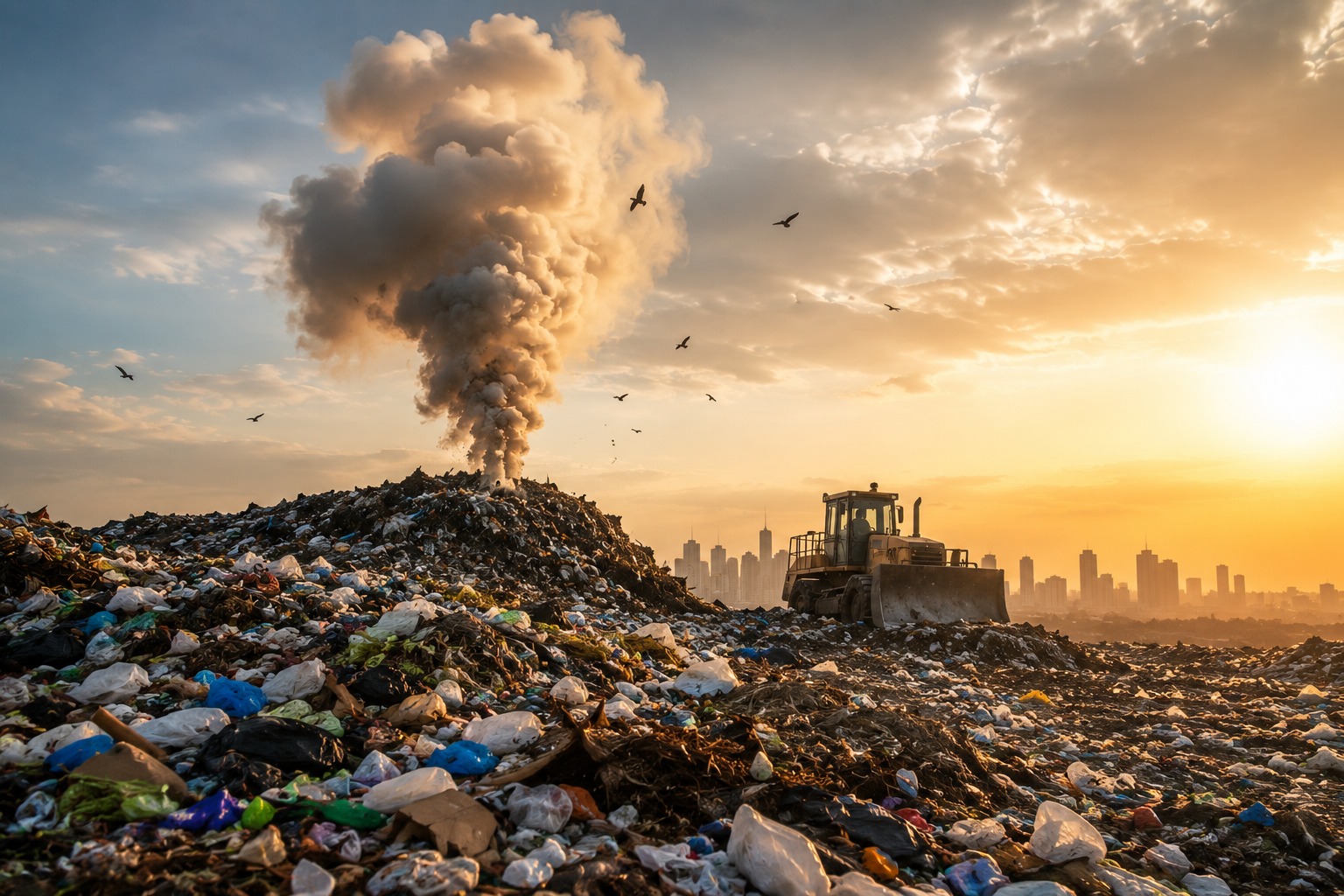
Recent satellite data has brought renewed attention to an often-overlooked climate issue, Methane emissions from landfills. A global study by the STOP Methane Project, using advanced monitoring from Carbon Mapper, identified landfill sites in Secunderabad and Mumbai among the world’s largest methane “super-emitters” in 2025.
This finding highlights a critical reality: waste management is no longer just an urban issue, it is a significant climate and ESG concern.
Understanding Methane Emissions from Landfills
Methane is produced when organic waste such as food scraps and biodegradable materials decompose in the absence of oxygen. This process is common in unmanaged or poorly managed landfills, where mixed waste is dumped without proper segregation or treatment.
What makes methane particularly dangerous is its intensity. Over a short period, it is far more potent than carbon dioxide in trapping heat in the atmosphere. This means that even smaller quantities can have a disproportionately large impact on global warming.
Methane emissions from landfills are often underestimated in climate discussions, even though methane can have 86 times the warming impact of CO₂ over a 20-year period. This means relatively smaller methane leaks can create climate impacts equivalent to extremely large carbon emissions.
Why This Matters: Environmental and Health Impacts
The scale of emissions from landfills like those in Secunderabad and Mumbai is alarming. High methane emissions contribute significantly to climate change and lead to the formation of ground-level ozone, which affects air quality.
A 2025 satellite-based study found that some landfill hotspots were releasing nearly 5 tonnes of methane per hour. Using Global Warming Potential (GWP):
5*86 = 430 tonnes CO2e/hour
This means a landfill emitting 5 tonnes of methane per hour can create a warming impact equivalent to around 430 tonnes of CO₂ every hour. Over a full day:
430*24 = 10320 tonnes CO2e/day
That equals more than 10,000 tonnes of CO₂-equivalent emissions per day, comparable to emissions from nearly 1 million SUVs or a 500 MW coal-fired power plant.
For communities living near landfill sites, this translates into real risks:
As urban populations grow and waste generation increases, these impacts are likely to intensify unless immediate action is taken.
The Indian Context: A High-Risk, High-Opportunity Scenario
India’s rapid urbanisation and consumption patterns have led to a sharp rise in municipal solid waste. A large portion of this waste remains unsegregated, with organic material ending up in landfills.
At the same time, this presents a major opportunity. Improving waste management systems, especially segregation, composting, and methane capture, can significantly reduce emissions in a relatively short time frame. Compared to other sectors, the waste sector offers some of the fastest and most cost-effective climate mitigation options.
For perspective, avoiding methane emissions from just 1,000 tonnes of landfill waste can prevent nearly 776 tonnes of CO₂-equivalent emissions. In many cases, this can have a climate impact comparable to removing hundreds of passenger vehicles from roads annually.
Landfills Through an ESG Lens
Methane-emitting landfills sit at the intersection of all three ESG pillars:
Environmental (E) | Social (S) | Governance (G) |
Landfills are a major source of greenhouse gas emissions. Reducing methane emissions is essential for climate action and aligns with global sustainability goals. | Communities living near landfill sites often face health risks, poor living conditions, and environmental injustice. Addressing landfill emissions directly improves quality of life. | Effective waste management requires strong policies, enforcement, and accountability. Gaps in governance, such as poor implementation of segregation rules, are key drivers of the problem. |
Many ESG discussions focus heavily on carbon dioxide from energy and transport sectors. However, methane reduction can produce faster climate benefits due to its higher short-term warming potential and faster atmospheric response when reduced. Satellite monitoring is also revealing that landfill emissions may be significantly underreported, increasing pressure for better ESG disclosures, transparent emissions monitoring, and waste-sector accountability.
Moving Forward: From Waste to Resource
Addressing methane emissions from landfills requires a shift in how waste is perceived and managed. Some key solutions include:
Technology, policy, and public participation must work together to make these solutions effective.
Want to know more?
Contact us at info@ceroed.com
Visit www.ceroed.com
#Landfills #ESG #ARRO #CeroED #Sustainability #WasteManagement
CEROED PTE LTD
25 Bukit Batok Crescent #09-05,
Singapore 658066
info@ceroed.com
www.ceroed.com
CeroED Technologies Pvt Ltd
17/1680/5, 1st floor,
Chelsma Heights, Poojappura,
Thiruvananthapuram 695012,
Kerala, India
Copyright @CeroED 2023. All rights reserved.